You bought a dresser for $40 and sold it for $150. That's a $110 flip, right?
Not quite. The paint, the new pulls, and the two trips across town all came out of that $110 before any of it was yours. Most resellers know their sale price to the dollar and their real profit only roughly. The gap between the two is where a busy month can turn out to be a break-even one.
This post walks through the full cost of a flip, the three numbers worth tracking on every sale, and how to set a price that leaves you the profit you planned on.
What a flip actually costs you
The purchase price is the obvious cost. It's rarely the only one:
| Cost | What it covers | How it hits you |
|---|---|---|
| Cost of goods | What you paid for the item or lot | Usually the biggest single cost |
| Platform fees | Final value, payment processing, promoted listings | Percentage of every sale; zero on most local cash sales |
| Supplies | Paint, hardware, cleaning, packaging | Per item, easy to forget |
| Travel | Gas for pickup and drop-off | Per trip, adds up on bulky items |
Three numbers for every sale
Once every cost is on the table, three numbers tell you how a flip went:
- Net profit — sale price minus fees, cost of goods, supplies, and travel
- ROI — net profit divided by total cost
- Margin — net profit divided by sale price
ROI tells you how hard your money worked. Margin tells you how much of each sale you keep. A flip can have a great ROI and a thin margin, or the reverse, so it helps to watch both.
A worked example
Back to the dresser:
- Bought for $40
- Paint and new pulls: $28
- Gas for pickup and delivery: $12
- Sold locally on Marketplace for $150, cash, no fees
Total cost is $80, so the $150 sale leaves $70 in net profit — an ROI of +87.5% and a margin of 46.7%. That's still a solid flip. It's also $40 less than the number you'd have guessed from the purchase and sale prices alone.
Price backward from the profit you want
When a platform takes a percentage, adding your target profit to your cost isn't enough — the fee comes out of the higher price too. Work backward instead:
list price = (total cost + target profit) / (1 - fee rate)
For the dresser on a 13.6% platform: ($80 + $70) ÷ 0.864 = $173.61. List it at $175. The fee on $175 is $23.80, which leaves $151.20 — your $80 back plus $71.20 profit.
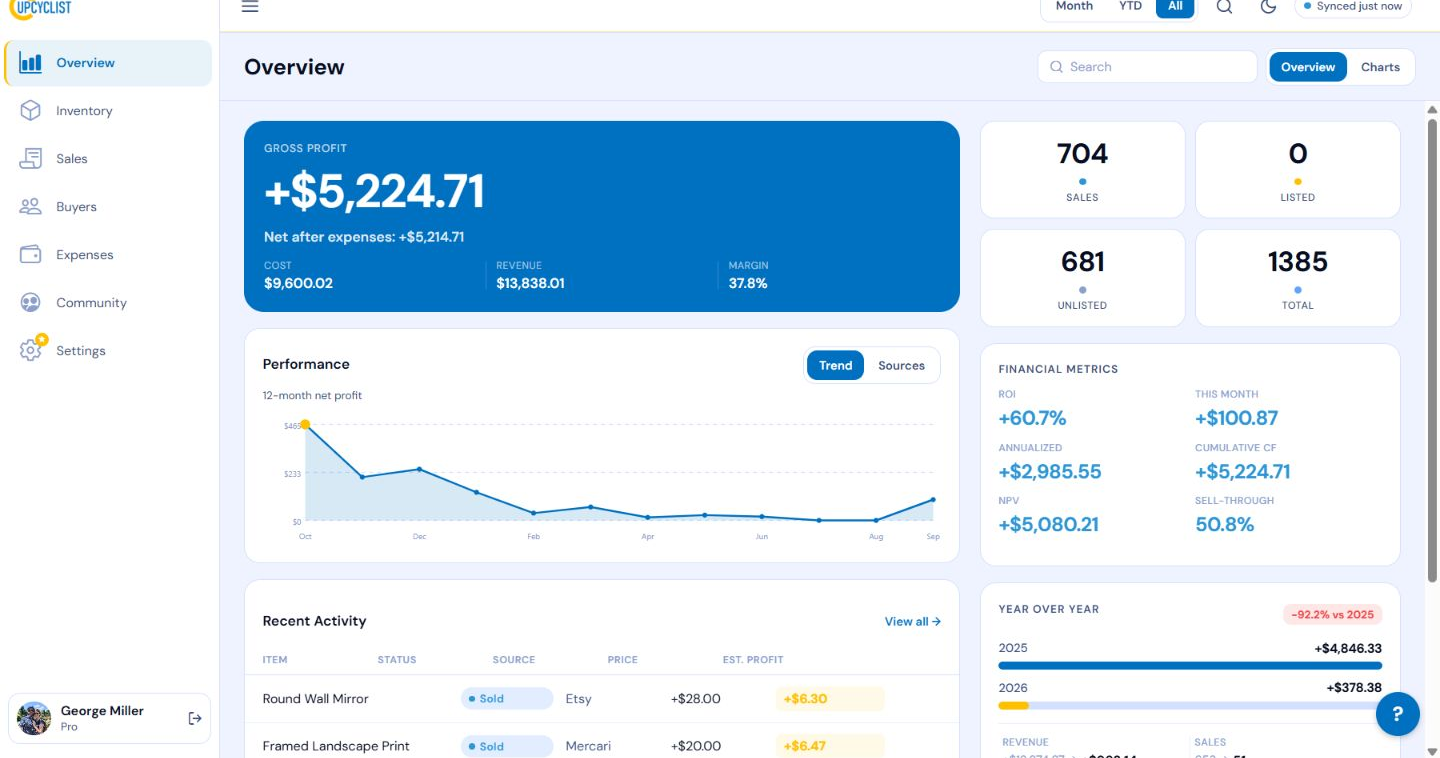
Track cost of goods, supplies, and fees on every sale in Upcyclist and it calculates net profit, ROI, and margin for you automatically — no spreadsheet required.
Once you're tracking the real cost of every flip, the pattern becomes obvious: some categories consistently return more per dollar and per hour than others. That's the next place to look when deciding what to source next.